HMO guidance
HMO fire risk assessment in Reading
Find out what a shared house fire risk assessor in Reading checks, why the council asks for one before issuing a licence, and how long the visit takes. Learn what happens if the report lists works that need doing.

Why Reading Borough Council asks for an HMO assessment
A landlord applying for a licence to let a shared house in Reading will usually be asked for proof that fire safety has been considered. The hmo licence fire safety requirements set by Reading Borough Council mean a documented assessment is expected before tenants move in or when a licence is renewed.
The council officer reviewing the application looks at the findings and any actions listed. If the building falls short, the licence may be delayed or refused until the problems are fixed. A landlord fire assessment in Berkshire follows the same legislation as anywhere else in England, but local officers apply it to the housing stock they see most often: converted Victorian terraces and mid-century semis split into bedsits.
Anyone managing a house in multiple occupation needs this document in place. The [responsible person duties](/rules/responsible-person-duties-reading) under fire safety law fall on whoever controls the building, which is typically the landlord or their appointed agent. Getting the assessment done early avoids last-minute delays when the licensing team asks for paperwork.
What the assessor looks at in a converted terraced house
When a shared house fire risk assessor in Reading walks through a property let to five tenants, the visit covers every shared space and the structure separating each room. The specialist examines escape routes first, checking that hallways and stairs remain clear and lead directly to a final exit.
In a converted terrace, walls and floors between rooms must resist fire long enough for everyone to get out. The assessor checks for holes around pipes, missing plasterboard, or gaps where cables pass through walls. These breaches defeat compartmentation, and a separate [compartmentation survey](/compartmentation-survey-reading) might be recommended if the layout is complex.
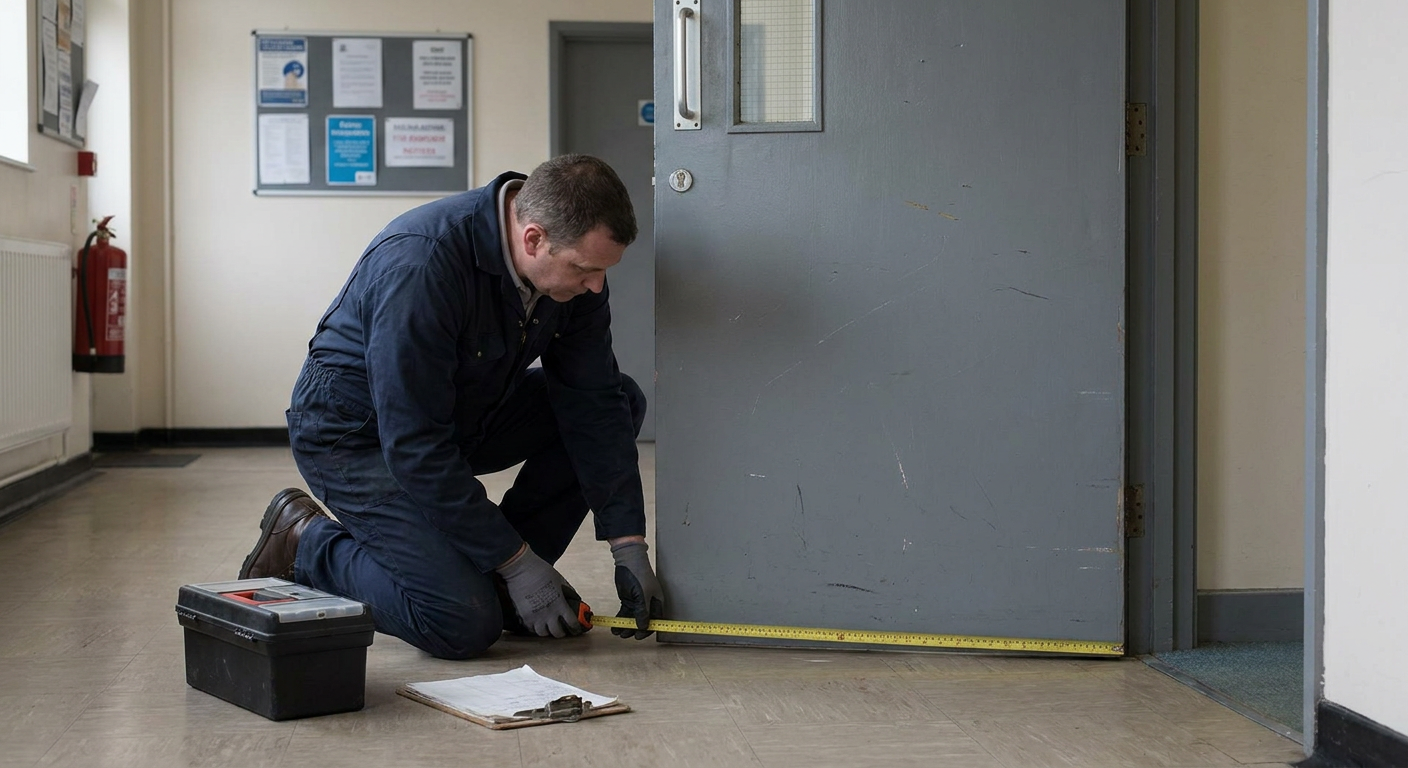
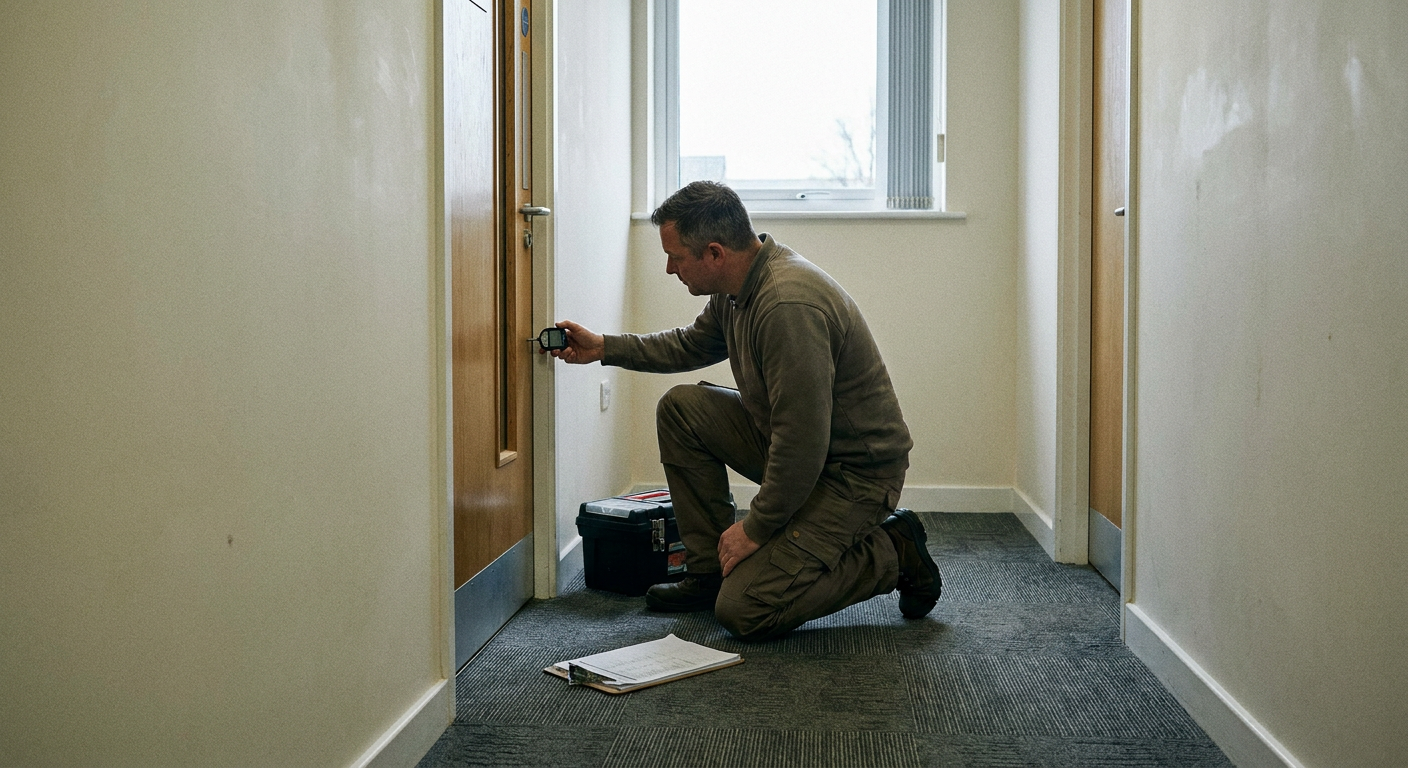
Fire doors receive close attention. The specialist measures gaps around the edges, checks intumescent seals, and tests whether the self-closing device pulls the door shut fully every time. Poorly fitted doors are one of the most common failures found during a council HMO inspection in Reading. Kitchens, boiler cupboards, and rooms with higher ignition risks are checked for appropriate separation from sleeping areas.
Electrical points, heaters, and cooking facilities are noted. The assessor records anything that could start a fire or help one spread, then sets out what needs changing.
Smoke alarms and detection grades in shared houses
Landlords often ask whether existing interlinked smoke alarms will satisfy the licensing conditions or if a new system is required. The answer depends on the size of the house, its layout, and the grade of equipment already installed.
HMO fire doors and alarms work together as a package. Detection must wake sleeping occupants early enough for them to use the protected escape route. In a small two-storey shared house, mains-wired interlinked heat and smoke alarms (often called Grade D) can be sufficient. Larger properties, or those with three or more storeys, typically require a Grade A panel system with detectors in every room and circulation space. The difference between these setups is covered in the guide to [fire alarm grades](/updates/fire-alarm-grades-in-reading-flats-grade-a-to-grade-d).
The specialist checks whether the current alarms are positioned correctly, whether they link properly, and whether they have battery backup. If the existing setup does not match the risk profile of the building, the report will state what is needed. Replacing a few heads is different from installing a full panel system, and the recommendation reflects the actual hazard rather than a blanket rule.
How long the visit takes and who needs to be there
An assessment of a typical five-bedroom converted house in Reading usually takes between one and two hours. The exact time depends on the number of rooms, the complexity of the layout, and how easily the specialist can access loft spaces, basements, and utility cupboards.
Tenants do not all need to be present, but the assessor must be able to enter every room. If a bedroom is locked and the occupant is out, that part of the building cannot be evaluated, which leaves a gap in the report. Landlords arranging the visit should give tenants advance notice so doors are unlocked or someone is home to open them.
[Booking the assessment](/rules/booking-a-fire-risk-assessment) involves confirming the address, the number of storeys, and the current occupancy. The specialist arrives with the tools needed to measure door gaps and test alarm call points. Once the physical inspection is complete, the findings are written up off site. The turnaround for the finished document is usually a matter of days, though this varies with the firm carrying out the work.
The written report and what the council accepts
Reading Borough Council expects a formal document that records what was found, what the risks are, and what action is required. The specialist produces a written report structured around recognised methodology, noting each hazard, rating its severity, and setting a deadline for remedial work.
This report is what the licensing officer reads. It must be clear enough for someone who has not visited the building to understand the condition of the escape routes, the detection system, and the structural fire separation. Vague summaries or verbal assurances are not accepted; the council requires the written record.
If the property needs an overarching plan rather than just an inspection, a [fire strategy](/fire-strategy-reading) document might be recommended alongside the assessment. For larger HMOs or those with vulnerable occupants, the report may also reference evacuation procedures. The key point is that the document serves as evidence of compliance, and it must stand up to scrutiny from the housing enforcement team. Landlords keep a copy for their records and provide another to the council when requested.
Common failures and what happens when works are listed
Across Reading, the problems found in shared houses tend to repeat. Doors that do not close fully because of swollen timber or broken hinges top the list. Missing cold smoke seals allow fumes to travel along corridors before flames even arrive. Thumb-turn locks fitted incorrectly, blocking a fast exit, are another frequent issue.
Detection systems often fall short because alarms have been painted over, removed by tenants, or never upgraded after a conversion. Escape routes blocked by bicycles, furniture, or stored boxes appear in many reports. These are the issues a council officer looks for during an inspection.
When the report lists works, the responsible person must arrange for them to be completed within the stated timeframe. The specialist who wrote the report identifies what needs doing but does not carry out the repairs. Separate contractors handle the physical work. If fire doors need replacing or adjusting, a [fire door inspection](/fire-door-inspection-reading) firm can verify the new installations meet the standard. The cost of an HMO fire risk assessment is separate from the cost of any remedial work, and landlords should budget for both once the findings are known.
Choosing the right assessment for your HMO
Different buildings present different hazards, so the scope of the visit changes depending on the layout and occupancy.
Building type
- Standard HMO assessment
- Converted houses up to three storeys
- Assessment with strategy
- Larger HMOs or purpose-built blocks
Focus
- Standard HMO assessment
- Hazards, doors, alarms, escape routes
- Assessment with strategy
- Includes overall fire engineering approach
Report use
- Standard HMO assessment
- Supports a mandatory licence application
- Assessment with strategy
- Satisfies planning or major refurbishment
Follow-up
- Standard HMO assessment
- Remedial works listed individually
- Assessment with strategy
- May require a separate design review
The specialist advises which format suits after inspecting the building and reviewing the layout.
Questions about HMO assessments in Reading
Answers to the things landlords ask before booking a visit to a shared house in Reading or the surrounding areas.
- Licence requirement
- Reading Borough Council expects a documented assessment as part of the HMO licensing process. Without it, the application stalls.
- Existing alarms
- Whether current interlinked alarms are accepted depends on their grade and coverage. The specialist determines if they suit the building.
- Tenant presence
- All tenants do not need to be home, but every room must be accessible. Locked bedrooms delay the inspection.
- Report acceptance
- The council officer reviews the written report. It must follow recognised methodology and clearly state findings and deadlines.
- Cost and timing
- The fire risk assessment cost for an HMO depends on size and complexity. Turnaround times vary between specialist firms.
- Fixing failures
- Separate contractors carry out listed works. The assessor writes the report but does not perform the repairs.
Arrange an HMO assessment in Reading
Send the details of your shared house and a specialist firm will respond with availability and next steps. Submitting an enquiry does not commit you to a booking or a fee.
- No obligation to proceed
- Local specialists respond
- Clear pricing provided